
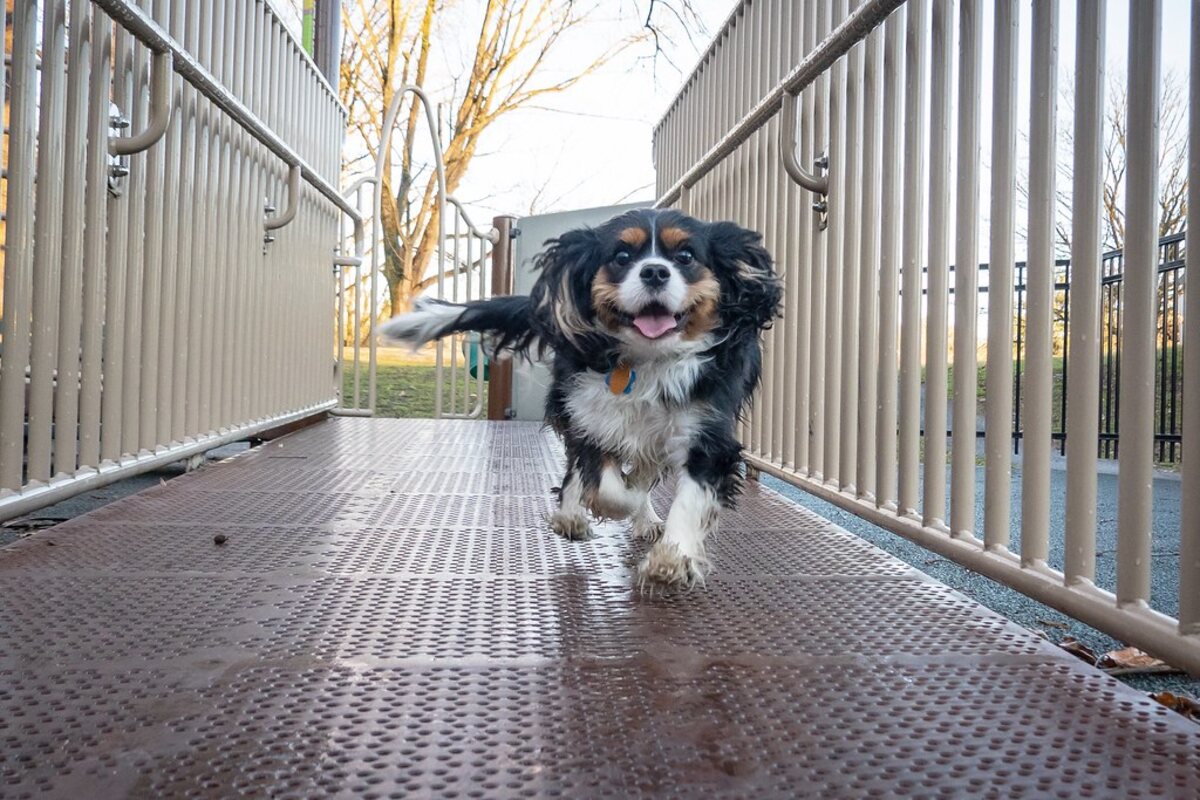
About an hour of exercise a day, split into two or three walks, is enough for a Cavalier. It is an adaptable breed: it will go to the mountains with you if you go, but it is equally content with a quiet city rhythm.
This article explains how much exercise is needed at each age, why a puppy is allowed considerably less than it thinks, and where the limits set by the heart lie in this breed.
The adult dog
For a healthy Cavalier of one year and over:
- about sixty minutes a day in total
- split into two or three walks
- at least one of them longer and calmer, with free sniffing
The breed can handle considerably more. Cavaliers go hiking and on long outings without trouble, provided the dog is fit and the load is increased gradually.
What the breed does not tolerate is the opposite: a dog that only goes out for fifteen minutes to relieve itself puts on weight and develops boredom behaviours — chewing, barking, pestering the household.
The puppy: the rule most often broken
With a puppy you do not go by how much it wants, but by how much it is allowed. The joints and growth plates are not ready for the load a puppy gladly takes on.
The usual guideline is five minutes of walking per month of age, twice a day. A three-month-old puppy — twice fifteen minutes. At five months — twice twenty-five.
This refers to a structured walk. Free play in the house and garden does not count, because there the puppy stops of its own accord when it tires.
What to avoid in the first year:
- long flights of stairs, especially going down
- jumping off the sofa and out of the car
- running alongside a bicycle
- long runs on hard surfaces
In a small breed prone to slipping kneecaps, these are not theoretical warnings.
The limits set by the heart
The Cavalier is a breed with a known risk of mitral valve disease. In a dog with a diagnosis, how much exercise and at what intensity is is decided by the vet — that is not for the owner to judge.
The general rule with a heart patient is that moderate, regular activity is kept up, because complete rest is harmful, while sudden strenuous outings are avoided. Better a little every day than a lot once a week.
Signs that the dog has gone past its limit:
- lagging behind and asking to stop
- panting that does not stop even after a few minutes of rest
- coughing during or after exertion
- sudden weakness or stumbling
In this breed a cough after exertion is not a matter of fitness but a reason for a heart examination.
Sniffing counts
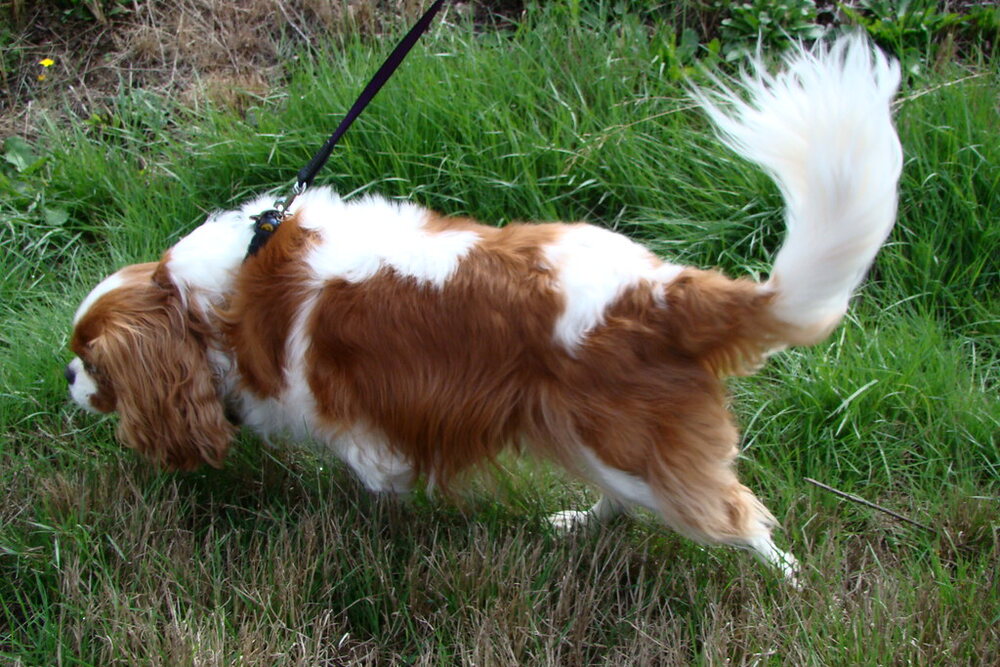
Half an hour in which the dog walks slowly and sniffs tires it more than half an hour of brisk heelwork. Scent engages the largest part of a dog’s brain and burns energy that walking does not.
In practice: at least one walk a day should be one in which the dog chooses the pace and the direction. In dogs that are “never tired”, this often does more than an extra kilometre.
When the amount changes
In summer walks move to morning and evening and get shorter. The Cavalier copes badly with heat because of its shorter muzzle.
In winter walks often shorten by themselves. Since the food is usually not reduced, winter is when Cavaliers most easily gain weight.
In an older dog the total time stays similar but is spread over more, shorter outings at a slower pace. Stopping walks in an old dog speeds up muscle loss and makes the joints worse.
After surgery or injury — strictly as instructed by the vet.
Does a garden replace a walk
No. In a garden a dog mostly lies about, and what a walk gives besides movement — new smells, people, sounds, situations — a garden does not have.
A Cavalier with a big garden that is never taken out is often less well socialised and inclined to bark at everything passing the fence.

Signs that there is not enough exercise
- weight gain despite the same amount of food
- “zoomies” in the evening in an adult dog
- chewing furniture and barking for no reason
- pestering and constant demands for attention
- restless sleep
And conversely: a dog that collapses after a walk and sleeps for hours, that limps or refuses the next outing, is getting too much.
Conclusion
An adult Cavalier needs about an hour a day across two or three walks, at least one of them at the dog’s own pace with free sniffing. With a puppy, keep to the rule of five minutes per month of age twice a day, and avoid stairs and jumping in the first year. In a dog with a heart diagnosis the vet sets the amount, and a cough after exertion is a sign for an examination, not for more training.
Note: this article is informational and does not replace examination and advice from a veterinarian.
Related
- A Cavalier in a flat: how to set up the space
- Play and mental stimulation for the Cavalier
- Travelling with a Cavalier: car, plane and paperwork
- Mitral valve disease (MVD) in the Cavalier
- The Cavalier in summer: heat, walks and heatstroke
- Cavalier care — an overview of all topics
- Puppies for sale from a kennel with health-tested parents


