
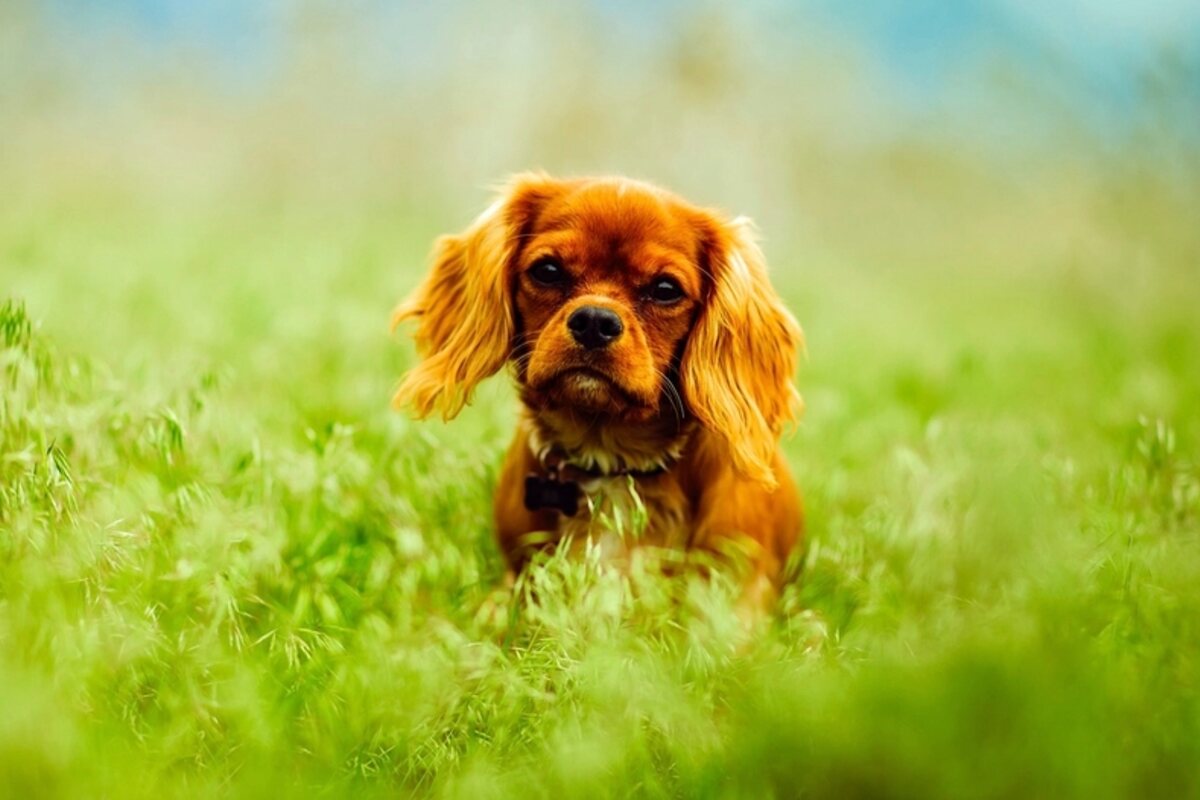
The Cavalier copes with heat less well than most breeds of its size. Its muzzle is shorter than in the shepherd breeds, and a dog cools itself only by breathing — a shorter muzzle means weaker cooling.
This article explains why the breed is sensitive to heat, how to organise a summer day, what the signs of heatstroke are and what to do in the first minutes.
Why this breed is more sensitive
Dogs do not sweat through the skin. They cool themselves by breathing fast and evaporating moisture from the tongue and mucous membranes. The longer the muzzle, the larger the surface for evaporation.
The Cavalier belongs to the breeds with a slightly shortened muzzle. It is not in the same category as a pug or a bulldog, but it is considerably worse equipped for heat than, say, a border collie.
Two further reasons: the long coat holds heat, and the dog is low to the ground, so its body is close to hot asphalt, where the air temperature is considerably higher than at a person’s head height.
What a summer day looks like
- Walks early in the morning and late in the evening. Between ten and six the dog goes out only to relieve itself, and only into the shade.
- The palm test on the asphalt. If you cannot hold your palm on the surface for five seconds, it is too hot for paws too.
- Water always available, both at home and on walks. A folding bowl fits in a pocket.
- Shorter and slower walks. Summer is not the time for new exertions.
- A cool spot indoors — tiles in the hall or bathroom, a cooling mat, a place out of the sun.
A fan helps less than it does for people, because the dog has no sweat for the air to evaporate. An air conditioner genuinely helps.
Clipping in summer — it does not help
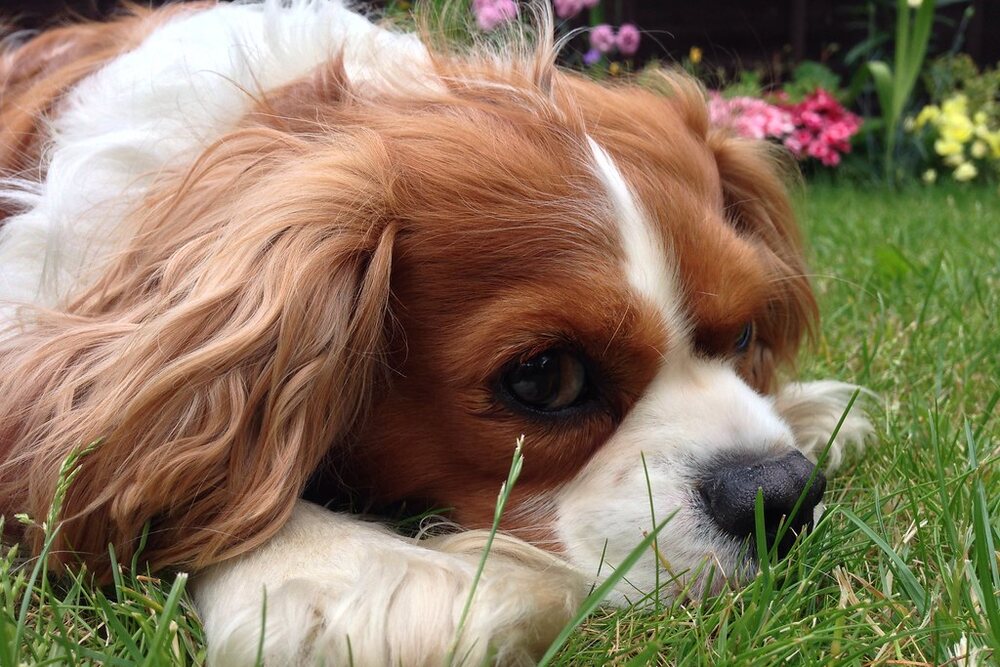
A common piece of advice is to clip a long-coated dog to make things easier for it. With the Cavalier that does not work.
The coat is not only insulation against cold but also protection from the sun and from the skin overheating. A clipped dog gets sunburn and cools no better, because it does not cool through the skin anyway.
On top of that, in this breed the coat often does not grow back with the same texture after clipping. Instead of clipping — regular brushing, which removes shed hair and lets air reach the skin.
When the risk is greatest
Heatstroke does not require tropical heat. It happens most often in these situations:
- A dog left in a car. Even at twenty-five degrees, with the window ajar, the interior passes forty in under fifteen minutes. This is the commonest cause of death from overheating in dogs.
- Play in the sun. A dog will not stop by itself when it is hot — it will keep running after the ball.
- Humid air. At thirty degrees with high humidity, cooling by breathing practically stops working.
- A crate or a carrier without airflow.
Signs of heatstroke
The order is roughly as follows, and the further down the list the dog is, the more serious the condition:
- rapid, shallow panting that does not stop
- copious, thick drool
- gums bright red, later pale or bluish
- restlessness, then sudden weakness
- staggering, uncoordinated gait
- vomiting or diarrhoea, sometimes with blood
- loss of consciousness
A dog that lies down and stops panting has not cooled off — that is deterioration.
What to do immediately
The aim is gradual cooling on the way to the vet — not instead of it.
- move the dog into shade or an air-conditioned space
- pour over it lukewarm to cool water, over the belly, groin and paws
- direct airflow onto the wet body
- offer water if the dog is conscious, but do not force it to drink
- straight to the vet, even when the dog looks better
Do not use ice or iced water. Sudden cooling constricts the blood vessels in the skin and actually slows the release of heat from deep in the body, and it can also cause shock.
The reason you still go to the vet even after successful cooling is that kidney damage and clotting disorders appear hours later, when the dog already seems recovered.
Water and swimming
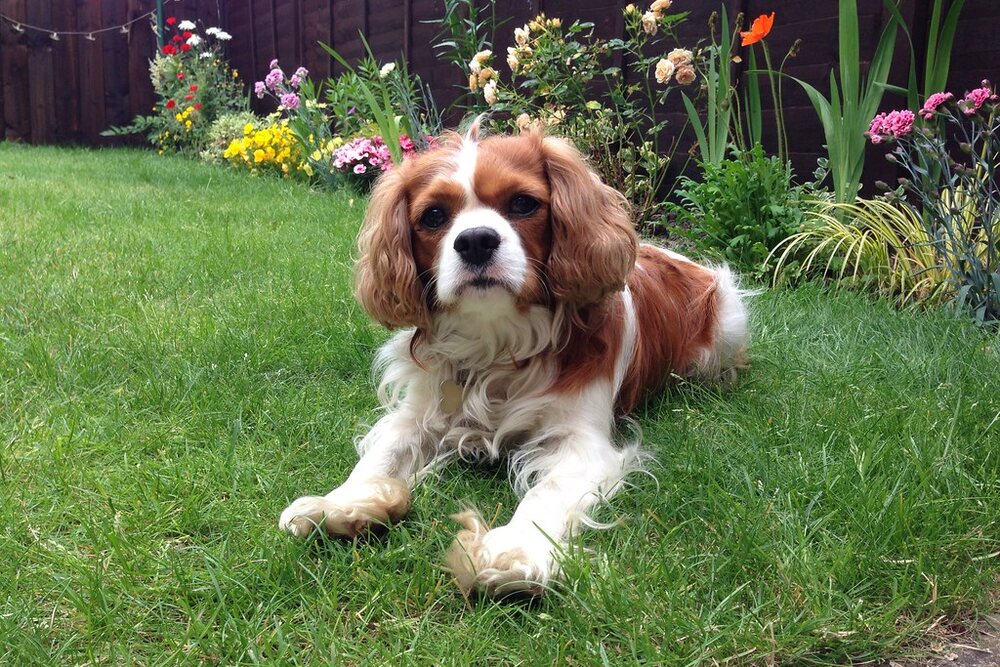
Most Cavaliers like shallow water. Swimming is a good summer activity, with three provisos:
- the dog is never left unsupervised by water, not even in a garden pool
- after swimming, the ears are dried thoroughly, because water in the ear is a common cause of infection in a drop-eared breed
- after a pool the dog is rinsed free of chlorine, and after a lake check for leeches and that the water was not stagnant and green
Conclusion
In summer a Cavalier is walked morning and evening, is never left in a car and is not clipped “to make it easier for him”. A dog that pants and cannot settle, with thick drool and bright red gums, is cooled with lukewarm water and driven to the vet — even if it recovers on the way.
Note: this text is for information only and does not replace examination and advice from a vet. Heatstroke is an emergency.


