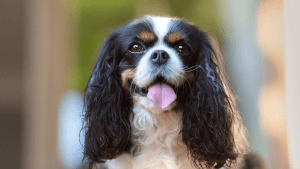
Short answer: a healthy adult Cavalier should not be left alone for more than 4 to 6 hours, and whenever possible it is better to stay under 4 hours. A considerably stricter rule applies to puppies — roughly one hour per month of age. The Cavalier King Charles Spaniel is a breed bred to be a human companion and tolerates solitude worse than most other breeds.
How many hours is safe — by age
The time a dog can spend alone depends first of all on age, because puppies do not yet have bladder control or the ability to calm themselves.
- Up to 10 weeks: about 1 hour at most. During this period the puppy is building basic trust and should not be left alone.
- 3 to 6 months: as many hours as it has months — a three-month-old puppy at most three hours, a four-month-old at most four.
- Over 6 months: usually up to 6 hours, provided the dog has been accustomed gradually.
- Adult Cavalier: 4 to 6 hours as the upper limit. Some sources recommend even shorter periods because the breed is strongly attached to its owner.
These rules are not arbitrary — they follow from bladder control, the need for movement and the social contact a puppy requires during development.
Why the Cavalier tolerates solitude worse than other breeds
The Cavalier King Charles Spaniel did not originate as a working or guard dog. For centuries it was bred exclusively as a companion, and this is clearly visible in its behaviour. In the literature the breed is often described as a "velcro dog" — one that wants to be as physically close to its person as possible, follows them from room to room and feels best in the presence of the family.
That very trait which makes the Cavalier an outstanding family dog is why it is more prone to separation anxiety than many other breeds. What is normal independence in a terrier can be a source of real stress for a Cavalier.
Signs of separation anxiety
It is important to distinguish boredom from anxiety. Anxiety begins soon after the owner leaves and follows a recognisable pattern:
- excessive barking, whining or howling that starts within the first few minutes
- scratching at doors and windows or attempts to escape the room
- destruction of objects, most often right around the exit from the flat
- continuous pacing along the same path
- soiling indoors in a dog that is otherwise fully house-trained
If several of these signs appear together, the problem is not a lack of discipline but stress — and it is solved by gradual habituation, never by punishment.
How to get your dog used to being alone
The method cited in the professional literature as the most reliable is gradual desensitisation: exposure to absence in intervals so short that the dog has no chance to become distressed, with very slow lengthening.
1. Establish the starting point. Film the dog with a camera and see how many minutes it stays calm. That is your starting point — not what you think it ought to manage.
2. Start with seconds, not hours. Walk to the door and open it without going out. Close it and come back. Then step outside and return immediately. The goal is for the dog to learn that leaving is not a special event.
3. Lengthen very slowly. Increase the absence in small steps, sometimes by just a few seconds. Always return before the dog begins to show unease — if you found it distressed, the step was too big.
4. Repeat several short departures a day. Several short exercises give a better result than one long outing.
5. Watch for the key milestone. When the dog stays calm for about 90 minutes, it is generally ready for longer periods — at that point you move on to four hours and gradually further.
Throughout the process, toys that occupy attention help, as do a walk and play before leaving: a tired dog settles more easily.
What not to do
Emotional goodbyes on leaving and an excited welcome on return amplify the difference between your presence and your absence. A calmer departure and arrival make it easier for the dog to adjust.
Punishment for destroyed items does not help, because the dog does not connect the punishment with behaviour from several hours earlier — it only increases fear and worsens the problem.
When the Cavalier is not the right breed for you
This question is worth answering honestly before getting a dog, not afterwards. If you are regularly away for ten or more hours a day and have no way for someone to walk the dog in between, a Cavalier probably will not be happy in such a household. There are breeds that tolerate solitude far more easily.
If, on the other hand, you work from home, have a family that takes turns, or can arrange a midday walk, the Cavalier will repay you with exceptional devotion — precisely the devotion for which this breed has been chosen for centuries.
Conclusion
The Cavalier King Charles Spaniel can learn to stay alone, but it needs gradual habituation and a realistic daily schedule. The upper limit for an adult dog is four to six hours, considerably less for a puppy — and the key lies not in the length but in the manner: short, calm and predictable departures from the earliest age produce a dog that experiences solitude as a normal part of the day rather than as a loss.