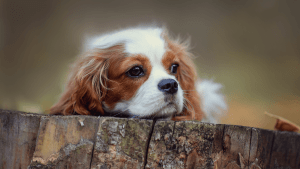
A puppy that bites is not being disobedient — it is doing exactly what it is equipped to do. A dog explores the world with its mouth, and during teething chewing is a physical need, not a choice.
This article explains why a puppy bites, how it learns that hands are off limits, what to do about damaged furniture and when chewing in an adult dog means something else.
Why a puppy bites
Three reasons, and each calls for a different response:
- Exploration. A puppy has no hands. Everything new goes into the mouth first.
- Teething. Between the fourth and seventh month the gums hurt and pressure relieves them. Chewing then is not mischief but relief.
- Play. Puppies play with each other using their mouths. If there is no other dog in the house, your hands are next in line.
In the Cavalier, nipping rarely turns into anything serious — the breed has no tendency to aggression — but a habit acquired in puppyhood stays with the adult dog if it is not redirected.
Hands are not a toy
This is the one thing taught from day one, without exception.
When teeth touch skin, the game stops. No shouting, no smacking, no snatching the hand away — just stopping. You stand up, turn away, ignore the puppy for ten seconds or so, then carry on.
The message the puppy gets is clear: teeth on skin mean the end of the fun. For a dog as strongly attached to people as the Cavalier, the loss of attention is a powerful consequence and this works quickly.
What not to do:
- Do not snatch the hand away. A fast movement triggers the urge to grab — it turns into a game.
- Do not play with your hands. If today you may tickle its muzzle with your fingers, you cannot ask it tomorrow to tell the difference.
- Do not squeeze the muzzle and do not hit. In a sensitive breed that produces a dog afraid of hands, and the biting does not stop.
If there are children in the house, the rule must apply to them too. Children scream and pull their hands away, which for a puppy is the perfect game — so encounters are supervised until the habit passes.
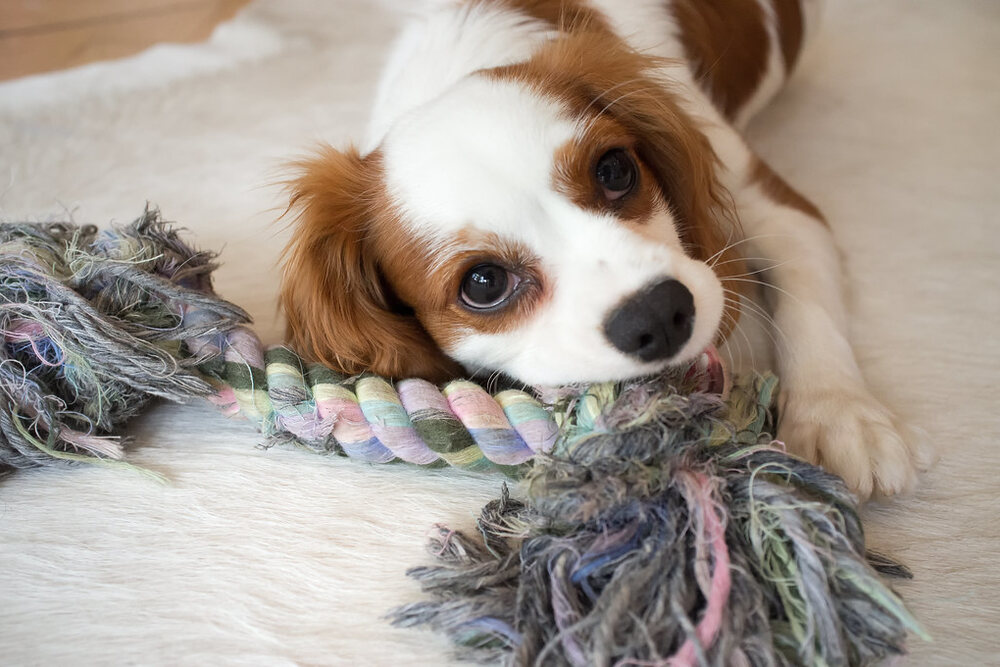
Instead of a hand — something else
A prohibition without a replacement does not work. Every “no” must come with a “here, this instead”.
What suits a small breed:
- rubber toys of the softer kind, in a size suited to small jaws
- toys that can be filled with food, because they occupy the dog for longer
- a chilled cloth twisted into a rope, useful during teething
- toys rotated in and out — the dog tires of one that is always lying there
What to avoid with a Cavalier: bones, antlers and hard plastic toys. In a small breed they break teeth, and a fractured canine is a common finding precisely in dogs that were given them.
Damage to the furniture
Table legs, carpet edges, cables and shoes. The order of solving it is always the same:
First remove. Cables into trunking, shoes into the cupboard, dangerous plants out of reach. A puppy that cannot get at things does not learn a bad habit.
Then limit the space. An unsupervised puppy in the whole flat will find something. One room or a fenced-off area until it grows up solves most of the problem.
Then substitute. When it bites the wrong thing, calmly take it away and hand over a toy. When it starts chewing that — praise.
Scolding after the event does not work. The dog does not connect a slipper chewed an hour ago with your tone. The “guilty look” owners recognise is not remorse but a reaction to your mood.
When chewing means boredom
If the damage happens mostly while you are out, it is probably not about teeth.
The Cavalier is a dog that copes badly with being alone, and boredom quickly turns into chewing. The answer then is not a ban but tiring it out and occupying it before you leave — a walk, a short training session, a food toy.
There is also a difference worth knowing: a bored dog chews whatever it can reach, an anxious dog chews doors, door frames and windows — the exit points. If the damage concentrates there, along with howling and messing indoors although the dog is house-trained, it is separation anxiety, which is dealt with differently and with a professional.
When it stops
The worst period is between the third and seventh month. In most dogs it settles by the eighth to tenth month , once the permanent teeth are through.
An adult dog that occasionally chews something is normal. An adult dog that regularly causes damage has an unresolved reason — most often too little exercise, too little occupation or stress.
When it is not behaviour but health
- the puppy refuses hard food or chews on one side
- blood on toys or in the saliva for more than a few days
- a milk canine standing beside the permanent one after the seventh month
- persistent licking and nibbling of its own paws — that is skin, not behaviour
- swallowing inedible things, socks and stones
A swallowed sock in a dog this size is an emergency, not something to wait out.
Conclusion
A puppy bites because it is exploring and because its gums hurt, so it is redirected rather than forbidden: the game stops the moment teeth touch skin, and instead of a hand there is always a toy. The furniture is first moved out of reach, then the space is limited. In the Cavalier, which copes badly with being alone, damage in your absence is a separate story — and if it is aimed at doors and windows, the issue is anxiety, not teeth.
Related
- Cavalier puppy training: the first month
- House training a Cavalier puppy
- Recall training: how to teach your Cavalier
- Socialising a Cavalier puppy
- How long a Cavalier can be left alone at home
- Play and mental stimulation for the Cavalier
- Cavalier care — an overview of all topics
- Puppies for sale from a kennel with health-tested parents