Socialisation has a deadline. The period in which a puppy accepts new things most easily opens at around three weeks and practically closes by four months. What is missed in that window is much harder to make up later, and never fully.
This article explains what socialisation actually is, how to do it while the puppy has not had all its vaccinations, what to expose it to and in what order, and how to tell when it has been too much.
What socialisation is not
The commonest misconception is that socialisation means meeting as many dogs and people as possible. That is only one part of it, and not the most important.
Socialisation is getting the puppy used to the world it will live in — to surfaces, sounds, objects, situations and being handled — so that it later perceives them as ordinary and not as a threat.
The aim is not for the dog to like everything. The aim is for it to stay calm in the face of the unfamiliar.
Why it matters in the Cavalier
This breed is friendly by nature and rarely develops aggression. The problem that appears in an under-socialised Cavalier is a different one — fearfulness and withdrawal.
An unsocialised Cavalier does not attack; it hides behind its owner, trembles in front of strangers, panics at sounds and cannot leave the house without stress. That is harder to treat than to prevent.
On top of that, the breed is strongly attached to people and easily develops separation anxiety. Part of socialisation is getting used to being alone for short spells.
Before the vaccinations are finished
Here a conflict arises: the socialisation window closes before the vaccination course ends. The answer is not to wait.
What can safely be done:
- carry the puppy in your arms around town — it sees, hears and smells without touching the ground
- sit with it outside a shop or on a bench and watch the passers-by
- take it in the car, briefly and often
- invite guests to the house, of different ages and appearances
- allow meetings only with healthy, vaccinated adult dogs that you know
What to avoid until vaccination is complete: dog parks, places where many unknown dogs gather, and ground where you do not know who has passed through.
What to expose the puppy to
It is useful to work through a list, because in everyday life half of this gets skipped by accident.
Surfaces: parquet, tiles, carpet, grass, gravel, sand, a metal grating, stairs, a wobbly board.
Sounds: the vacuum cleaner, a hairdryer, the doorbell, a siren, a building site, traffic, thunder, children shouting.
People: children, older people, men with beards, people in hats, glasses, with umbrellas, walking sticks, bicycles.
Situations: a car ride, a lift, the vet’s surgery without an examination, a café, walking past a dog without greeting it.
Handling: paws, ears, mouth, tail, combing, wiping paws, standing on the scales.
How to do it properly
What matters is not how many things the puppy sees, but how it felt while seeing them. A bad experience is worse than none.
- Always at a distance where the puppy stays calm. If it looks and does not flee, the distance is right. If it backs away, you are too close.
- Let the puppy approach on its own. Never carry it towards what it fears, and do not let strangers take it out of your arms.
- A treat alongside the new thing, while the puppy is calm — that way the new becomes a promise of something good.
- Keep it short. A few minutes per outing is enough.
- One new thing a day, not five.
If the puppy gets frightened, comforting it will not “spoil” it — that is an old myth. What you should not do is make a drama of it; stay calm, increase the distance and let it watch from safety.
Meetings with other dogs
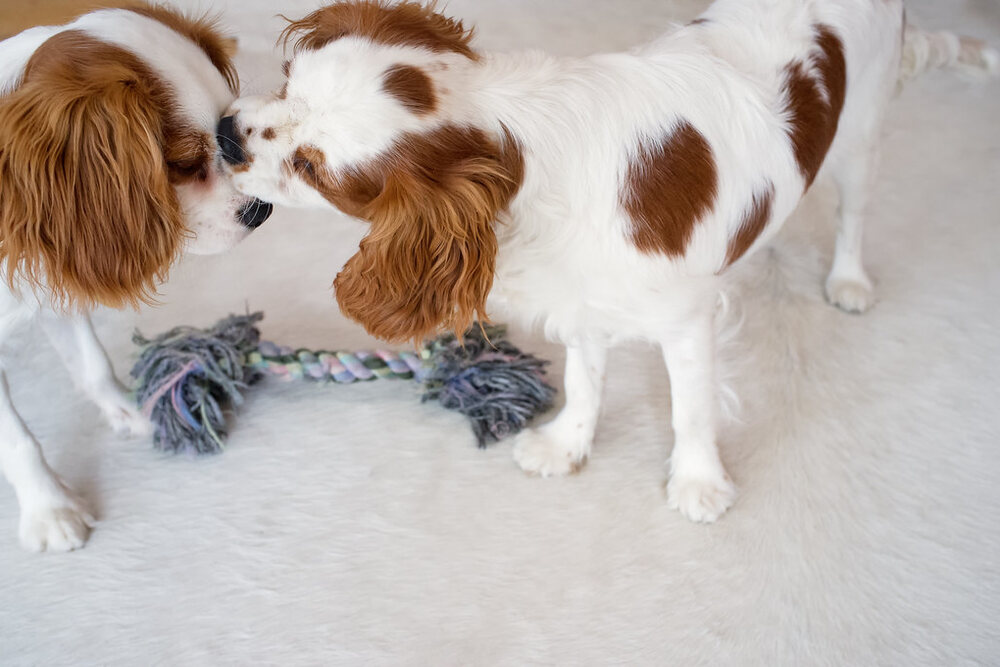
Quality matters more than quantity. One calm, well-mannered adult dog is worth more than ten puppies in chaos.
What to avoid:
- dog parks where dogs run loose without their owners watching
- meetings in which a big dog roughly knocks the puppy over — the Cavalier is small-framed and one bad experience leaves a mark
- meetings on a short, tight lead, because a tight lead in itself creates tension
A puppy class, if run by someone who works with rewards and controls the play, takes care of a large part of this at once.
Being left alone
This is taught in the same period, because it is the commonest later problem in this breed.
Start with a few seconds behind a closed door, then a minute, then five. Leaving and returning are not turned into an event — no goodbyes and no exuberant greetings. A puppy left alone before it becomes frightened learns that you always come back.
Signs that it has been too much
- tail tucked, ears back, body hunched
- turning the head away, licking the muzzle, yawning without being sleepy
- freezing and refusing a treat
- trying to escape or hide
A puppy that refuses food has crossed the line. Then you do not insist but withdraw to a distance and finish.
After the fourth month
The window closes, but the work does not stop. What was learned in that period has to be maintained throughout the whole first year, because between the sixth and twelfth month many dogs go through a passing phase of heightened wariness.
A dog that missed the early window can progress a great deal with patient work, but that is no longer socialisation — it is rehabilitation, and it is worth doing with a professional.
Conclusion
Socialisation takes place up to four months and is done even before vaccination is complete — by carrying the puppy in your arms, having guests at home and meeting known healthy dogs. It is measured by how the puppy felt, not by how many things it saw. In the Cavalier the consequence of a missed window is not aggression but a fearful dog that hides, and that is a state which takes years to improve afterwards.
Related
- Cavalier puppy training: the first month
- House training a Cavalier puppy
- Recall training: how to teach your Cavalier
- Nipping and chewing in Cavalier puppies, and damage at home
- How long a Cavalier can be left alone at home
- Play and mental stimulation for the Cavalier
- Cavalier care — an overview of all topics
- Puppies for sale from a kennel with health-tested parents