
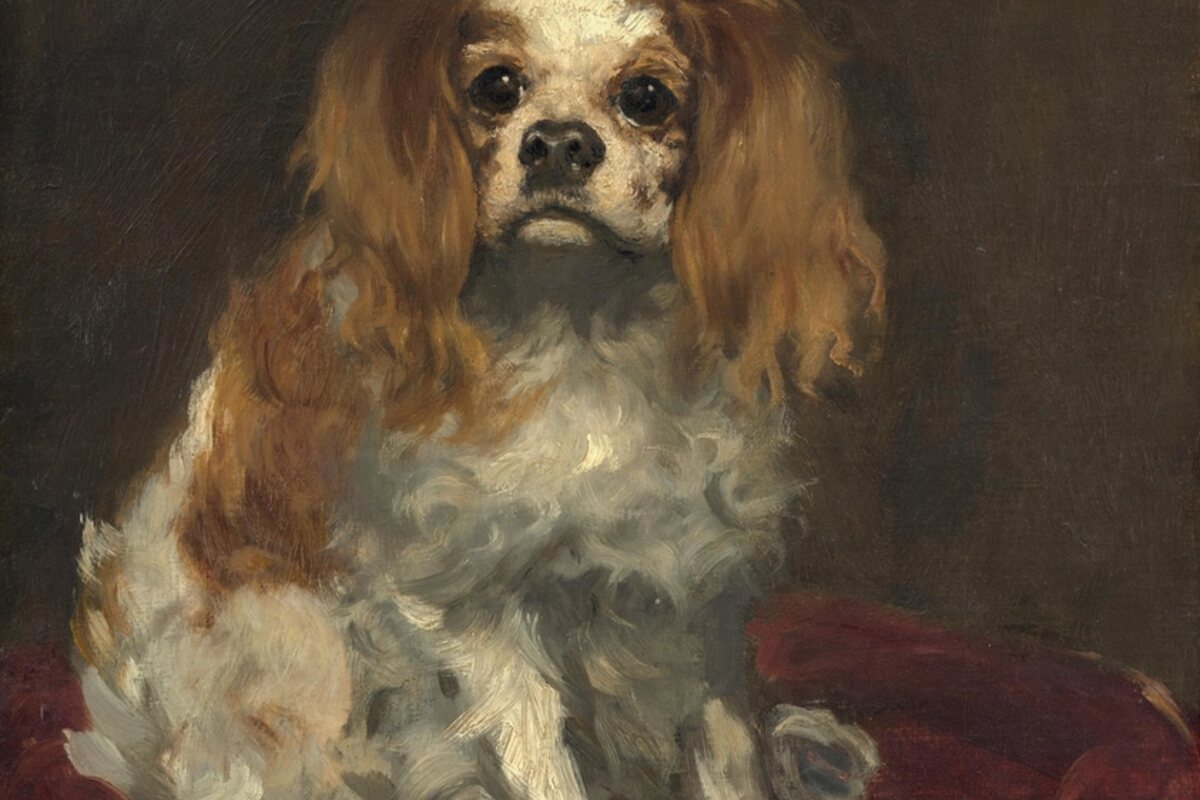
The Cavalier King Charles Spaniel is the only breed named after an English king, and one of the few that was literally brought back from the brink of extinction in the twentieth century. The story also explains why there are two similar breeds with almost the same name today.
This article follows the breed from seventeenth-century court portraits to today's standard, and explains how the Cavalier differs from the King Charles Spaniel.
The court dog of English kings
Small spaniels with long ears appear in European portraits as early as the sixteenth century, in the laps of noblewomen and beside children in family paintings.
The breed took its name from Charles II, who came to the throne in 1661. He was a passionate breeder and his spaniels followed him everywhere, even into council meetings. The nickname “the Merry Monarch” belongs as much to him as to the atmosphere those dogs brought with them.
That early image of the dog matters, because it later served as the yardstick when the breed was restored: a longer muzzle, a flat skull, a large dark eye and a gentle expression.
How the breed almost disappeared
After the death of Charles II in 1685, tastes changed. During the nineteenth century toy spaniels were crossed with flat-faced breeds, and the appearance shifted considerably.
By the middle of the nineteenth century the result was a dog with an entirely different head: a completely flat face, a domed skull, an undershot jaw and a large round eye. That dog is known as the King Charles Spaniel and still exists today as a separate breed.
The problem was that the old type, the one from the portraits, had practically vanished. There were no breeders keeping it alive, because the ring rewarded the new appearance.
The prize that brought the breed back
The turning point came in 1926 from an American, Roswell Eldridge, who placed an advertisement in a dog-show catalogue in England.
He offered a prize of twenty-five pounds for a male and the same for a female that best matched the description of the old type from the portraits, with smaller prizes for second and third place. The offer stood for five years running.
For the time the sum was substantial and it drew attention. Breeders began looking for dogs with a longer muzzle among litters that until then had been considered failures.
In 1928 the prize was won by a dog named Ann's Son, owned by Miss Mostyn Walker. That dog is taken as the starting point of the modern breed.
Recognition as a separate breed
The first breed club was founded in that same year, 1928. Breeders adopted a description to work from, and Ann's Son served as the living model.
The British Kennel Club recognised the Cavalier as a breed separate from the King Charles Spaniel. The word “Cavalier” in the name marks exactly that difference and is not decoration.
Eldridge did not live to see his idea bear fruit, but the breed he set in motion is today one of the most popular small breeds in the world.
Cavalier and King Charles Spaniel — two breeds, not one
This is the most common confusion among people just choosing a dog. These are two separate breeds with different standards:
- The Cavalier King Charles Spaniel is larger, weighing about five to eight kilos, with a longer muzzle and a flat skull.
- The King Charles Spaniel, known in America as the English Toy Spaniel, is smaller and weighs about three to six kilos, with a flat face and a domed skull.
Both breeds share the same ancestor and the same four colours, but they are judged separately in the ring and are not interbred.
What remains of that history in today's dog
The Cavalier was never a working dog. It did not guard flocks, did not hunt and did not defend property. For centuries it was bred for one thing only: to be with people.
That explains the traits owners mention most often today:
- a marked attachment to the household and unease when left alone for long
- an absence of territoriality and of suspicion towards guests
- the ease with which it fits into a flat and into a family with children
- a tendency to follow its person from room to room
What history shows as courtly luxury is seen today as temperament: a dog that does not want a job, it wants company.
A legacy that is not only pretty
Restoring the breed from a small number of dogs in the 1920s also left a consequence. The narrow genetic base contributed to the frequency of two inherited diseases, mitral valve disease and syringomyelia.
That is why a serious breeder today chooses not only by looks and pedigree but above all by the parents' health reports. It is the part of the breed's history that does not show in the portraits, yet it determines most of what kind of life the dog will have.
Conclusion
The Cavalier is a breed that once already disappeared and was brought back because someone cared that the dog from the old paintings should exist again. That story is not just a nice anecdote: it explains why the breed has a gentle temperament, why there is confusion with a similar name, and why careful choice of a litter matters more in this breed than in most others.
Related
- The Cavalier breed standard: what the judge looks at in the ring
- Cavalier colours: Blenheim, tricolour, black and tan, and ruby
- Cavalier size and weight: puppy growth month by month
- About the Cavalier King Charles Spaniel breed
- Traits and characteristics of the Cavalier King Charles Spaniel
- Drawbacks of the Cavalier King Charles Spaniel — what to know before buying
- Which breeds the Cavalier King Charles Spaniel most resembles
- Health of the Cavalier King Charles Spaniel — an overview of all topics
- Puppies for sale from a kennel with health-tested parents


