
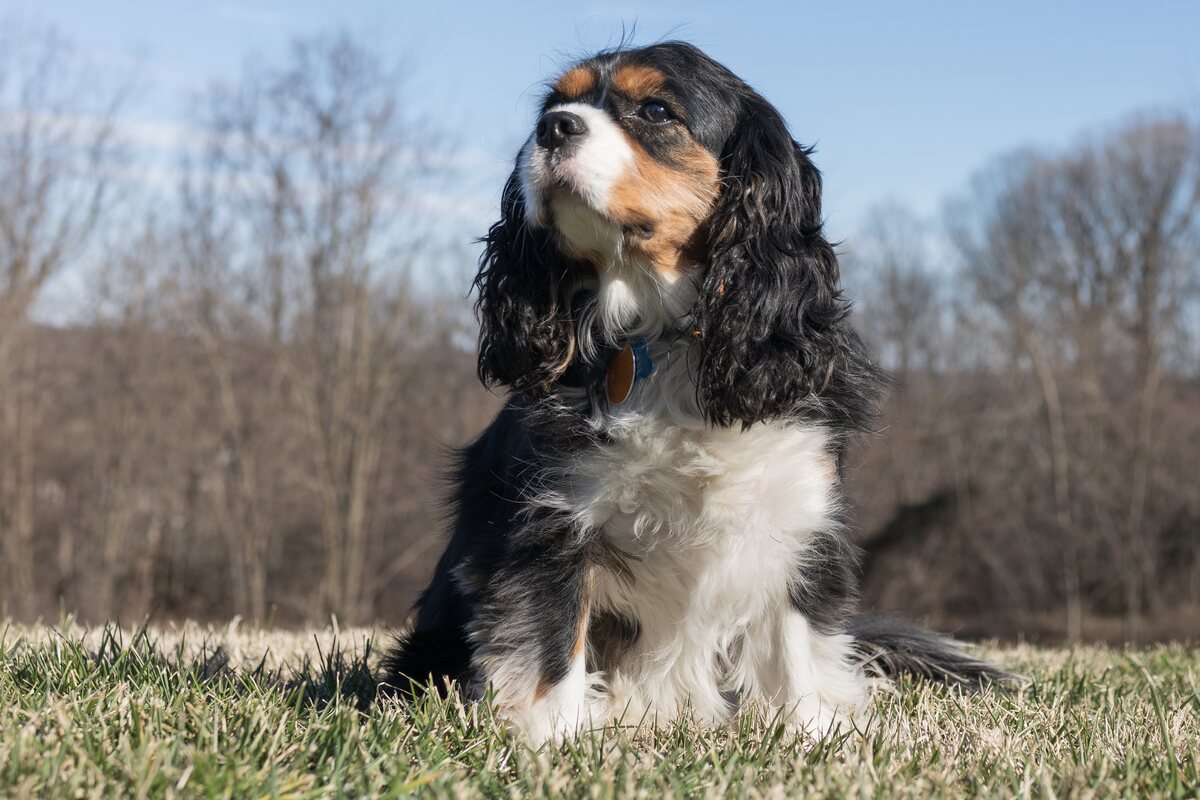
An adult Cavalier King Charles Spaniel weighs between 5.4 and 8 kilos. That is the only range the breed standard expressly prescribes, and a significant departure either way is not desirable.
This article gives the expected weight month by month, explains when a dog stops growing and how to check whether yours is in good condition.
Adult size
The Cavalier belongs to the small breeds, but not to the toy category of the very smallest dogs.
- Weight per the standard: from 5.4 to 8 kilos
- Height at the withers: in practice about 30 to 33 centimetres
- Build: harmonious, body length roughly equal to height
It is worth knowing that the breed standard prescribes only weight and does not mention height at all. The figure of around thirty centimetres is a commonly measured value in adult dogs, but it is not a criterion by which they are judged in the ring.
There is a difference between males and females, but it is smaller than in most breeds. Males are usually at the upper end of the range, females at the lower, but the ranges overlap.
There are no recognised “mini” or “toy” Cavaliers. If someone offers you a puppy with a promise that it will stay under four kilos, that is not a special line but either a departure from the standard or a sales story.
Expected weight by age
The following figures are indicative. A healthy puppy may be above or below them, and more important than any single number is that the weight rises steadily.
- 8 weeks: about 1.5 to 2 kilos
- 3 months: about 2.5 to 3.5 kilos
- 4 months: about 3.5 to 4.5 kilos
- 6 months: about 4.5 to 6 kilos
- 9 months: about 5.5 to 7 kilos
- 12 months: close to the final weight
A rough rule breeders use: the weight at four months multiplied by two gives the approximate adult weight.
When a dog stops growing
In Cavaliers growth in height finishes at around eight to ten months. After that the dog no longer grows taller, but the body is still taking shape.
The chest broadens and muscle fills out until about eighteen months. That is why a dog at one year often looks slimmer than the same dog at a year and a half.
The coat takes longest. The feathering on ears, legs and tail reaches full length only at around three years, so a young Cavalier looks considerably different from an adult.
How to check whether the weight is right
The number on the scales is less reliable than what you feel with your hand, because build differs from dog to dog.
The ribs should be felt by running the palm lightly over them, without pressing. If you have to search for them, the dog is carrying excess. If they are visible to the naked eye, the dog is too thin.
In addition, seen from above the dog should have a slight waist behind the ribs. Seen from the side, the line of the belly should rise towards the hind legs rather than run flat.
Why extra weight is more serious here than in other breeds
In a dog of seven kilos, half a kilo of excess is over seven percent of body mass. In a dog of thirty kilos the same half kilo is negligible.
On top of that, the Cavalier is a breed prone to mitral valve disease. A heart that already has a valve that does not seal has to work harder when it carries weight it does not need.
That is why in this breed the weight is measured and recorded at every check-up rather than estimated by eye.
When to see a vet
Growth rarely runs perfectly straight and small deviations are normal. An examination is warranted if:
- the puppy does not gain weight for two weeks running
- it suddenly loses weight with no change of diet
- at six months it weighs less than three kilos
- an adult dog goes over nine kilos
- it lags markedly behind its littermates
Size and living conditions
This size is why the breed fits well into a flat. A dog of six kilos fits in your lap, is easy to carry, does not need a large garden and travels well.
At the same time it is not so small as to be fragile, so it fits without worry into a family with children, given the usual understanding about how the dog is carried and when it should be left alone.
Conclusion
The Cavalier is a dog of five to eight kilos and around thirty centimetres at the withers, reaching its final weight at about a year and its final look only at about three. What is worth watching is not the exact number on the scales but whether the ribs can be felt with the palm without pressing — in a breed with a known cardiac risk, that check is worth more than any table.
Note: this article is informational and does not replace examination and advice from a veterinarian.
Related
- Origin and history of the Cavalier King Charles Spaniel
- The Cavalier breed standard: what the judge looks at in the ring
- Cavalier colours: Blenheim, tricolour, black and tan, and ruby
- About the Cavalier King Charles Spaniel breed
- Traits and characteristics of the Cavalier King Charles Spaniel
- Drawbacks of the Cavalier King Charles Spaniel — what to know before buying
- Which breeds the Cavalier King Charles Spaniel most resembles
- Health of the Cavalier King Charles Spaniel — an overview of all topics
- Puppies for sale from a kennel with health-tested parents


