
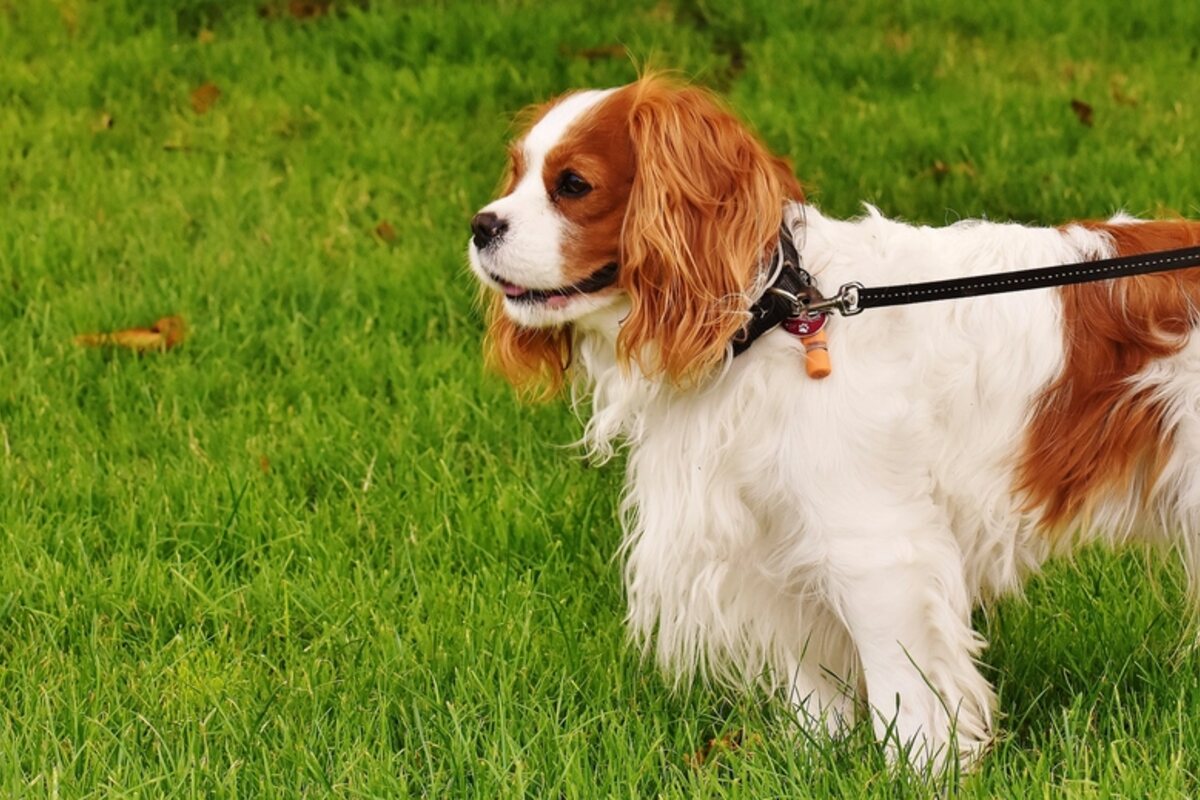
The breed standard is the written description by which the Cavalier is judged in the ring and by which breeders choose their breeding dogs. It is not a list of beauty points but a description of a build that lets the breed move and live as it should.
This article goes through the standard point by point and explains what the individual terms mean, because the wording is often opaque to someone choosing a puppy for the first time.
Where the breed sits in the classification
The Cavalier King Charles Spaniel is listed under number 136 in the classification of the Fédération Cynologique Internationale.
- Group 9: companion and toy dogs
- Section 7: English toy spaniels
- Without working trial
The last item is not a formality. It means the breed is judged neither on hunting, nor on guarding, nor on work — because it was never bred for any of that.
General appearance and temperament
The standard describes the breed as active, graceful and well balanced, with a gentle expression.
On temperament the description is unusually specific: sporting, affectionate, absolutely fearless, gay and friendly, with no tendency whatsoever towards nervousness and without aggression.
This is one of the few breeds in which timidity is expressly named as a fault. A Cavalier that shrinks from people or reacts with fear does not match the description of the breed, however handsome it may be.
Head
This is where the greatest difference lies compared with the King Charles Spaniel, a related but separate breed.
- Skull: almost flat between the ears, without a dome
- Stop: shallow, meaning the transition from forehead to muzzle is gentle rather than abrupt
- Muzzle: length from the base of the stop to the tip of the nose about 3.8 centimetres
- Nose: black, well developed, without pink areas
- Jaws: a correct scissor bite, where the upper teeth overlap the lower
That figure of 3.8 centimetres is the most concrete number in the whole standard, and it is exactly what separates the two breeds. A short, flat muzzle is not desirable in the Cavalier.
Eyes and ears
Eyes: large, dark and round, but not protruding. Set well apart. They are precisely what gives the gentle expression the standard expressly requires.
Ears: long, set high, with abundant feathering. When the dog is alert, the ears lift slightly at the base.
Body, tail and gait
Body: short-coupled, with a moderately wide chest and a level topline. Ribs well sprung.
Tail: in proportion to the length of the body, well set on, carried happily but never much above the level of the back. Docking is not done.
Gait: free and elegant, with good reach in front and strong drive from behind. Seen from the front and rear, the legs move parallel.
Coat
Long, silky and free from curl. A slight wave is permissible.
The standard expressly forbids trimming and shaping of the coat. The Cavalier is shown in the ring in its natural state. The only thing allowed is trimming the hair between the pads of the feet.
That sets it apart from many breeds where grooming is part of show preparation, and it is why caring for a Cavalier is simpler than it looks.
Colours
Four colours are recognised, two parti-colour and two whole colour:
- Blenheim: chestnut patches on a pearly white ground
- Tricolour: black patches on a white ground, with tan markings
- Black and tan: raven-black coat with tan markings, without white
- Ruby: a whole warm red, without white
In the whole colours, white hair is considered a fault. In the parti-colours, well-separated patches and a clean white ground are required.
Size
Weight from 5.4 to 8 kilos. A harmonious, small build within that range is required.
This is the only measurement the standard prescribes. Height at the withers is not mentioned in the standard at all, although in practice it runs to about thirty to thirty-three centimetres in adult dogs.
Faults
The standard does not list faults one by one but sets a general rule: any departure from the points listed is considered a fault, and the seriousness of the fault is in proportion to its degree and its effect on the health and welfare of the dog.
That last sentence matters more than it seems. It means a departure that harms the dog counts for more than one that is merely cosmetic.
Dogs with physical or temperamental faults that affect health are excluded from judging, and males must have both testicles descended into the scrotum.
What the standard does not cover
This is the part a future owner most often overlooks. The standard describes appearance and temperament, but it says nothing about the breed's inherited diseases.
A dog can match the standard perfectly and still have mitral valve disease or syringomyelia. That is why separate health testing programmes are used alongside the standard; they are not part of the judging in the ring but they are a condition for responsible breeding.
In other words, a show result and a health report are two separate things and one does not replace the other.
Conclusion
The Cavalier breed standard is short and unusually clear on temperament: it asks for a dog without fear and without aggression, of gentle expression, moving freely and with a coat not shaped by scissors. The two most useful things for a buyer to know are that a muzzle of about 3.8 centimetres is what separates the Cavalier from its related breed, and that the standard says nothing about health, so the parents' reports have to be asked for separately.
Related
- Origin and history of the Cavalier King Charles Spaniel
- Cavalier colours: Blenheim, tricolour, black and tan, and ruby
- Cavalier size and weight: puppy growth month by month
- About the Cavalier King Charles Spaniel breed
- Traits and characteristics of the Cavalier King Charles Spaniel
- Drawbacks of the Cavalier King Charles Spaniel — what to know before buying
- Which breeds the Cavalier King Charles Spaniel most resembles
- Health of the Cavalier King Charles Spaniel — an overview of all topics
- Puppies for sale from a kennel with health-tested parents


