
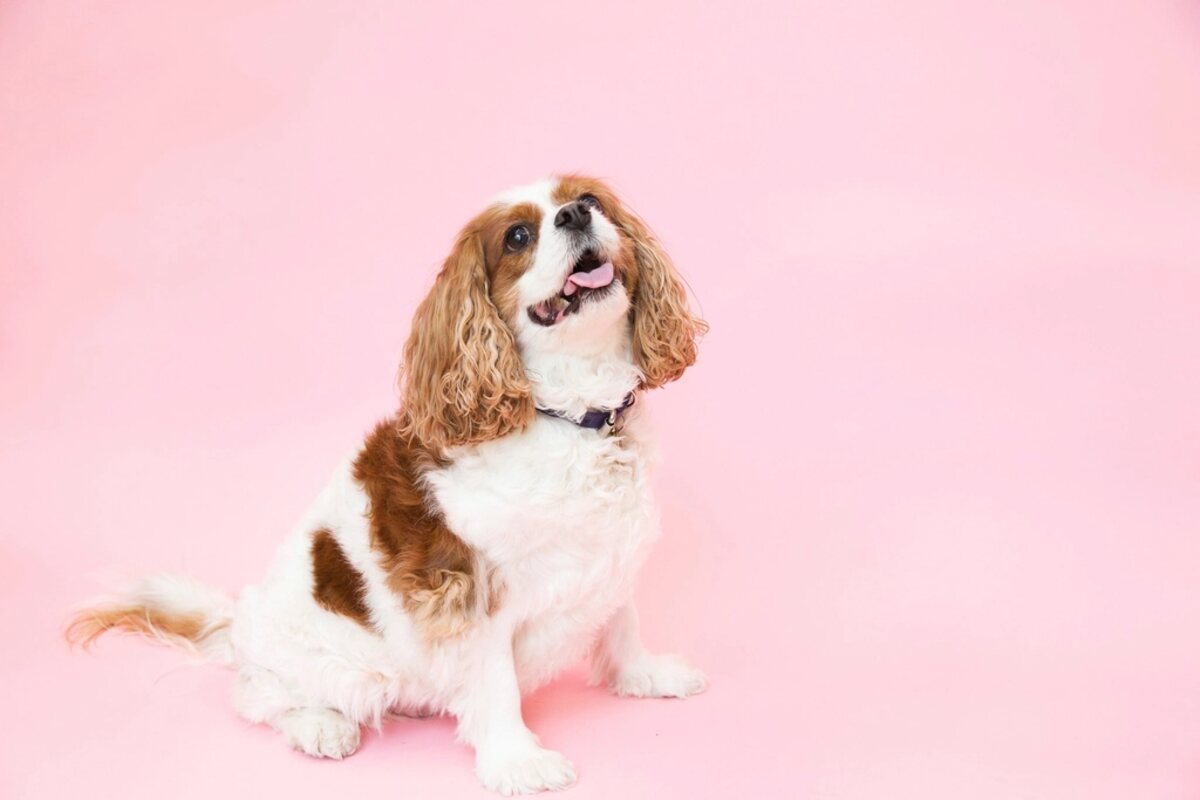
The Cavalier King Charles Spaniel is recognised in four colours, and all four are equally correct. None is a rarity in terms of value, none is more expensive than another, and none carries a different temperament.
This article explains how each of the four colours looks, what the standard requires, and what the terms you will hear from breeders mean.
Two groups: parti-colour and whole colour
The four colours fall into two groups, and that division matters more than it seems at first glance.
Parti-colours have a white ground with coloured patches. These are Blenheim and tricolour.
Whole colours have no white ground. These are ruby and black and tan.
The difference matters in breeding. Parti-colour is mated with parti-colour, whole colour with whole colour or with parti-colour, but crossing produces combinations the standard does not recognise, for example a whole-coloured dog with white patches. That is why a serious breeder plans the colour of a litter rather than leaving it to chance.
Blenheim
The best known and most common colour. Chestnut-red patches on a pearly white ground.
The standard asks for well-separated, evenly distributed patches and a clean white free of ticking. On the head a white blaze is required, dividing the coloured areas above the eyes and across the skull.
In the middle of that white blaze, on the skull between the ears, there is sometimes a round chestnut mark called the Blenheim spot. It is desirable but not required. A dog without it is an equally correct Blenheim.
The name comes from Blenheim Palace, the estate of the Dukes of Marlborough, where dogs of this kind were bred as far back as the eighteenth century.
Tricolour
Black patches on a white ground, with tan markings. Tan is a warm reddish colour that sits in precisely defined places.
The tan markings are required:
- above the eyes, as two dots like eyebrows
- on the cheeks
- on the inside of the ears
- on the inside of the legs
- under the tail
Here too the standard asks for well-separated patches and a white blaze on the head. In conversation the tricolour Cavalier is often shortened simply to tri.
Black and tan
Raven-black coat with tan markings in the same places as on the tricolour. Without a white ground.
This is the least often seen of the four colours, so you will often hear that it is more valuable. That is not true. It is rarer because fewer breeders work with it, not because the standard rates it higher.
With this colour the standard expressly does not want white hair. A white mark on the chest or feet is considered a fault, although it affects neither the health nor the character of the dog.
Ruby
A whole-coloured dog, the entire coat a warm reddish shade, with no white patches and no tan markings.
In the ruby the red should be as deep and as even as possible. Younger dogs sometimes have lighter shades that deepen with age. As with black and tan, white hair is considered a fault.
Ruby is most often confused with a lighter Blenheim by people who do not know the breed, but the difference is clear: a Blenheim always has a white ground, a ruby never does.
What colour does not mean
Several things are often attributed to colour that have nothing to do with it:
- Character. Colour does not affect temperament. Claims that rubies are calmer or tricolours livelier have no basis.
- Health. The breed's inherited diseases occur equally in all four colours. The parents' reports tell you about risk, the colour tells you nothing.
- Price. With a responsible breeder the price depends on the parents' examinations and the work invested, not on the colour of the puppy.
If someone charges you more because the puppy is of a “rare colour”, that is a sales argument, not a breeding one.
How colour changes as the puppy grows
The colour you see at eight weeks is not the final one.
In Blenheims and tricolours the patches often spread and darken. In rubies the red deepens, sometimes only by the second year. The tan markings on black and tans and tricolours become more pronounced.
In parti-colours it also happens that small coloured flecks appear on the white ground over time. This is common and is not considered a fault except in the ring, under strict judging.
Which colour to choose
Since colour carries neither health nor character, the choice is free and purely a matter of taste. The only practical difference is in grooming: on Blenheims and tricolours the white ground around the eyes and on the feet shows dirt and tear stains sooner.
Far more important than the colour is the question of whom you are getting the puppy from. Litters are planned months ahead and the colour is often the last thing to be known.
Conclusion
All four Cavalier colours are equal under the standard. Blenheim is the most common, black and tan the least often seen, but rarity here is no measure of quality. What separates a good puppy from a poor one is not the patches on its coat but the parents' health reports and the conditions the litter was raised in.
Related
- Origin and history of the Cavalier King Charles Spaniel
- The Cavalier breed standard: what the judge looks at in the ring
- Cavalier size and weight: puppy growth month by month
- About the Cavalier King Charles Spaniel breed
- Traits and characteristics of the Cavalier King Charles Spaniel
- Drawbacks of the Cavalier King Charles Spaniel — what to know before buying
- Which breeds the Cavalier King Charles Spaniel most resembles
- Health of the Cavalier King Charles Spaniel — an overview of all topics
- Puppies for sale from a kennel with health-tested parents


