Small breeds build up tartar faster than large ones, and the Cavalier is no exception. Their teeth are closely set in a small jaw, so plaque lodges between them more easily and hardens into tartar within a few days.
This article explains why that happens, how a dog gets used to tooth brushing, which aids work and which do not, and when scaling at the vet is needed.
Why small breeds in particular
The reason is space. The number of teeth is the same in every breed, but the Cavalier’s jaw is half the size of a medium breed’s. The teeth are crowded, touching at the sides, and food stays between them.
Plaque forms within a few hours, and hardens into tartar in two or three days. Plaque comes off with a brush; tartar no longer does — only a vet removes that.
That is the whole logic of dental care: the job is not to remove tartar but to stop plaque from turning into it.
Why it is not just a question of bad breath
Tartar pushes the gum back, opens a pocket between tooth and gum, and bacteria settle there. Chronic inflammation follows.
In the Cavalier this carries extra weight. Bacteria from inflamed gums enter the bloodstream and burden the heart, and this is a breed with a known cardiac risk. Neglected teeth in a Cavalier are not the same as neglected teeth in a healthy crossbreed.
What healthy teeth and gums look like
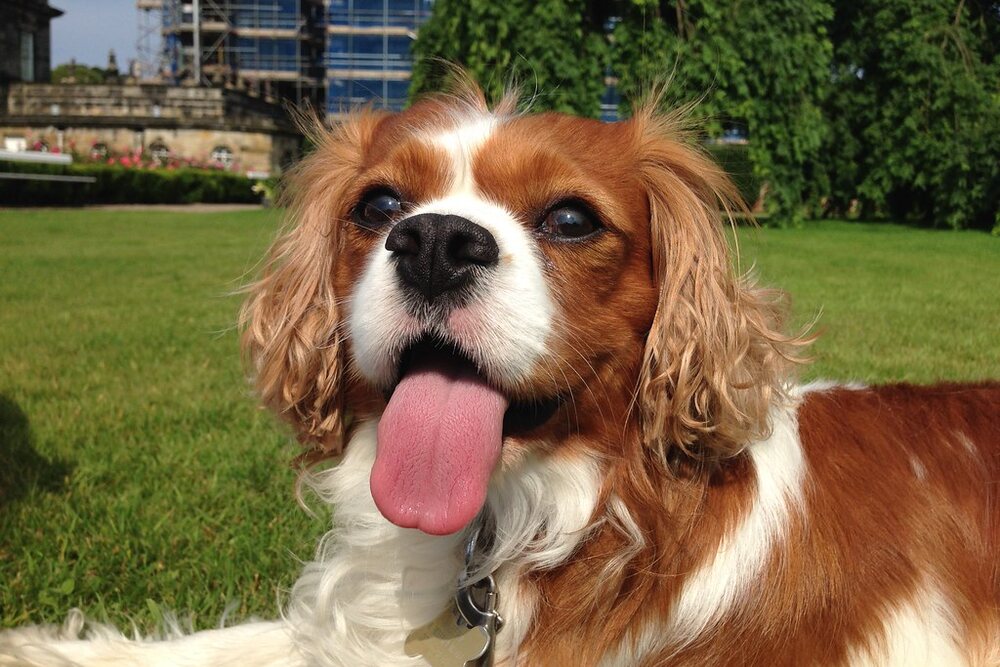
- teeth white to pale yellowish, with no brown deposits along the gum line
- gums pink, not red and not swollen
- gums do not bleed when touched
- breath mild and “doggy”, but not putrid
A brown line right along the gums is the start of tartar and a sign that brushing is too infrequent.
Brushing: how often
Ideally every day, realistically three or four times a week. Below that, plaque has time to harden.
Regularity matters more than duration. Thirty seconds every other day is worth more than five minutes once a week.
With what
Toothpaste for dogs only. Human toothpaste contains fluoride and sometimes xylitol — the dog swallows the fluoride because it does not spit, and xylitol is toxic to dogs even in small amounts.
For the brush there are three options:
- a soft children’s toothbrush — it does the job and is the cheapest
- a dog toothbrush with a longer handle — the molars are easier to reach
- a finger brush with rubber nubs — easiest to start with, but cleans less well
The finger brush is good for getting the dog used to it, but the aim is to move on to a brush, because only a brush reaches into the gum line.
How to get the dog used to it
This is not done all at once. The sequence that works for most dogs takes two to three weeks:
- For a few days: just lift the lip and let go. A treat.
- Then: a finger with a little paste for the dog to lick, so it learns the taste.
- Then: run a finger over the front teeth, two seconds.
- Then: the brush without paste, outside only, a few teeth.
- Only then: the brush with paste, one side a day.
The inner surface of the teeth does not have to be brushed. The tongue partly cleans it, and plaque mostly forms on the outside anyway. Insisting on the inside is the commonest reason a dog starts avoiding the brush.
The molars and canines matter most — that is where tartar forms first and most. The front incisors look the prettiest and matter least.
What helps besides brushing
None of the following replaces a brush, but they reduce plaque in between:
- Dry food leaves less plaque than wet food, but still leaves it
- Dental treats that the dog chews for a long time — chosen according to the dog’s size
- Chew Toys of softer rubber
- Water additives — they help with breath but have little effect on tartar
What to avoid: things that are too hard. Bones, antlers and hard plastic toys break teeth in a small breed. A fractured canine is a common finding in dogs that were given bones “to clean their teeth”.
Scaling at the vet
Once tartar has formed, the only way is ultrasonic scaling, and that is done under anaesthetic.
That is also why it gets put off — owners fear the anaesthetic. In a healthy dog the risk is small, but before the procedure a Cavalier’s heart is also checked, which is an annual duty anyway.
How often it is needed depends solely on care. A dog whose teeth are brushed regularly may go several years between procedures; a dog whose teeth are not brushed needs one every year or more often.
Scaling without anaesthetic, offered in some places, cleans only the visible part of the tooth. It does not reach below the gum line, where the problem is.
Teeth in the puppy
The milk teeth are replaced between the fourth and seventh month. During that time a puppy chews everything, and that is normal.
In small breeds it often happens that the milk canine does not fall out on its own but stays alongside the permanent one. If that happens the tooth is extracted, because a gap remains between the two teeth where food collects.
That is why a dental check is done after the seventh month, even if everything looks fine.
When to see a vet
- breath that has suddenly got worse
- gums red, swollen or bleeding
- the dog chews on one side or drops food
- brown deposits that will not come off with a brush
- a loose tooth in an adult dog
- a milk tooth standing beside a permanent one
Conclusion
In the Cavalier plaque turns into tartar in two or three days, so the only thing that really works is brushing three or four times a week, with dog toothpaste and on the outer surface of the teeth. Treats and additives help but do not replace it. In a breed with a known cardiac risk, healthy teeth are not a question of looks but one worry less for the heart.
Note: this article is informational and does not replace examination and advice from a veterinarian.
Related
- Cavalier coat care: brushing, mats and tools
- Bathing a Cavalier: how often and how
- Nail trimming and paw care for the Cavalier
- Tear stains under the eyes in Cavaliers
- Do Cavaliers shed, and are they hypoallergenic
- Mitral valve disease (MVD) in the Cavalier
- The senior Cavalier: what changes after the age of seven
- Cavalier care — an overview of all topics
- Puppies for sale from a kennel with health-tested parents